Campaign intelligence: turning a PRD into a scoring model
A spec asked for campaign alerts. Two of the four requested alert families were impossible with the data that exists — so I said so, then built a health-scoring model for the two that weren't.
Part of the Retail Media Network Portal project.
What was asked for
A PRD landed for a Campaign Warnings & Alert Notification Center. Nine deliverables, condensed:
- —One alert-evaluation service writing typed alerts
- —Delivery alerts — under/over-delivery against the expected daily plan, configurable deviation
- —Creative alerts — rejected, pending, undeliverable
- —Performance alerts — low correlation between impressions and attributed sales
- —A per-campaign recommendations-and-alerts column in both products' listings
- —A centralized Warnings & Alerts Center
- —Per-alert actions: Fix It, Refresh, Report Issue
- —Report Issue → an automatic support ticket carrying campaign context
- —A feature flag, since this changes shared components across both products
The first thing I built was an inventory of what was impossible
Before writing any code, I wrote the portal-side reading of the PRD: what it asks for, what this
codebase can support today, and what it cannot support at any amount of effort. Three annotations —
// observed for facts pulled from the code, ❓ for open questions, [BLOCKED] for things
requiring something outside the portal to exist first.
What already existed (so I built on it rather than beside it): a health signal in the campaign
listings, per-ad creative status in both vocabularies (processed/failed on the retailer side,
approved/in-review/rejected on the advertiser side), a toast service with actions, badges and
modals, feature-flag infrastructure, and the new semantic status tokens for severity.
What was missing, and mattered:
- —No notifications system at all. The header bell was decorative — a hardcoded count of 3, no panel, no store, no data.
- —No expected daily delivery plan. Campaigns carry start date, end date, impressions, spend and a progress figure — but that progress is network receipt progress (how far ads have propagated to their screens), not delivery pacing. There was no per-day target and no pacing curve.
- —No sales-attribution data. No service, no field, not even a mock. The page that would own it was a placeholder route.
- —No shared campaign store. Every listing page owned a private array of campaigns. Nothing aggregated across pages, let alone across products — and an alerts center in the retailer product that reports on advertiser campaigns needs exactly that layer.
So of the four requested alert families: delivery and creative were buildable — delivery only after inventing the daily plan the model lacked. Performance (impressions-to-sales correlation) was blocked on data that does not exist anywhere in the system, and predictive alerting was explicitly out of scope. Reporting that up front turned a feature that would have quietly shipped two-thirds done into one with an honest, defined scope — and it named the two upstream dependencies as work someone else has to do.
From alerts to a scoring model
The PRD asked for alerts. Alerts answer "what is wrong with this campaign?" — but the question an operator actually opens the portal with is "which campaigns should I look at first?" A list of alerts doesn't rank; a score does.
So the service produces both: a 0–100 health score with three weighted components, plus the typed alerts that explain it.
Pacing — measured against the elapsed flight, not the total
A campaign can be perfectly on track for its total target and badly paced today. Pacing is scored against the expected plan for the days elapsed:
private pacingScore(c: AlertCampaign): number {
  const expected = c.expectedDailyImpressions * c.elapsedDays;
  if (expected <= 0) return 100;              // hasn't started — nothing is wrong with it
  const ratio = c.impressionsToDate / expected;
  if (ratio <= 1) return clamp(ratio * 100);  // under-delivery scores linearly
  return clamp(100 - (ratio - 1) * 100 * 0.5); // over-delivery penalised at half rate
}
Three judgments in nine lines, and each is a product decision rather than a formula:
- —Under-delivery is linear. At 42% of plan you have delivered 42% of what you sold. There's no need to editorialize.
- —Over-delivery is a milder fault, so it's penalised at half rate. It still spends the budget early and risks going dark before the flight ends — but the impressions were served. Treating it as symmetrical with under-delivery would rank a campaign that over-delivered alongside one that didn't deliver, and operators would learn to distrust the score.
- —A campaign that hasn't started scores 100, not 0. The absence of delivery before the start date isn't a problem, and a scoring model that flags it teaches people to ignore it.
Creative — the share of ads that can actually serve
private creativeScore(c: AlertCampaign): number {
  if (c.totalAds <= 0) return 100;
  const blocked = c.rejectedCreatives + c.pendingCreatives * 0.5;
  return clamp(((c.totalAds - blocked) / c.totalAds) * 100);
}
A rejected creative is a hard zero for its ad — it will never serve as-is. A pending one counts as half: temporarily blocked, not refused. The half-weight is the difference between "this campaign is broken" and "this campaign is waiting", which is the difference between an alert someone acts on and an alert someone mutes.
Reach, and the renormalisation that keeps the score honest
Not every campaign records a reach figure. The naive handling — treat a missing component as zero — silently caps a perfectly healthy campaign at 85. So when reach is absent, the remaining weights renormalise:
const divisor = reach === null ? HEALTH_WEIGHTS.pacing + HEALTH_WEIGHTS.creative : 1;
Dropping a component must not look like failing it. This is the kind of detail that decides whether people trust a score enough to sort by it.
Alongside the score: a forecast (plan-rate recovery across the remaining days, flagged at risk below 95% rather than 100%, since a rounding-margin shortfall isn't news) and risk flags (underpacing, overpacing, low reach, creative-blocked) that say what kind of trouble a campaign is in without requiring the reader to interpret the number.
Surfacing it in four places, with one rule each
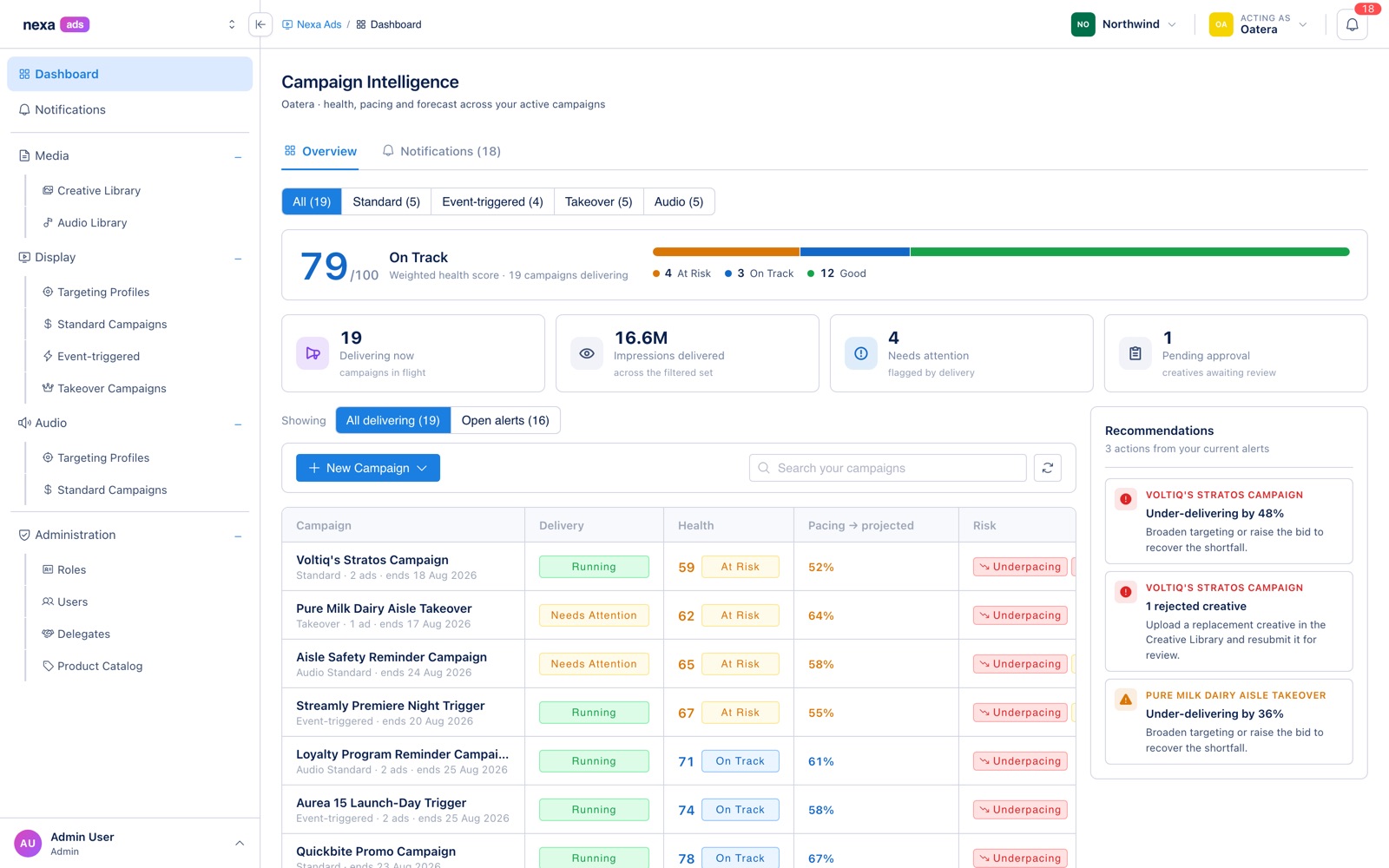
The listing column — health and open alerts inline, so triage happens before anything is opened.
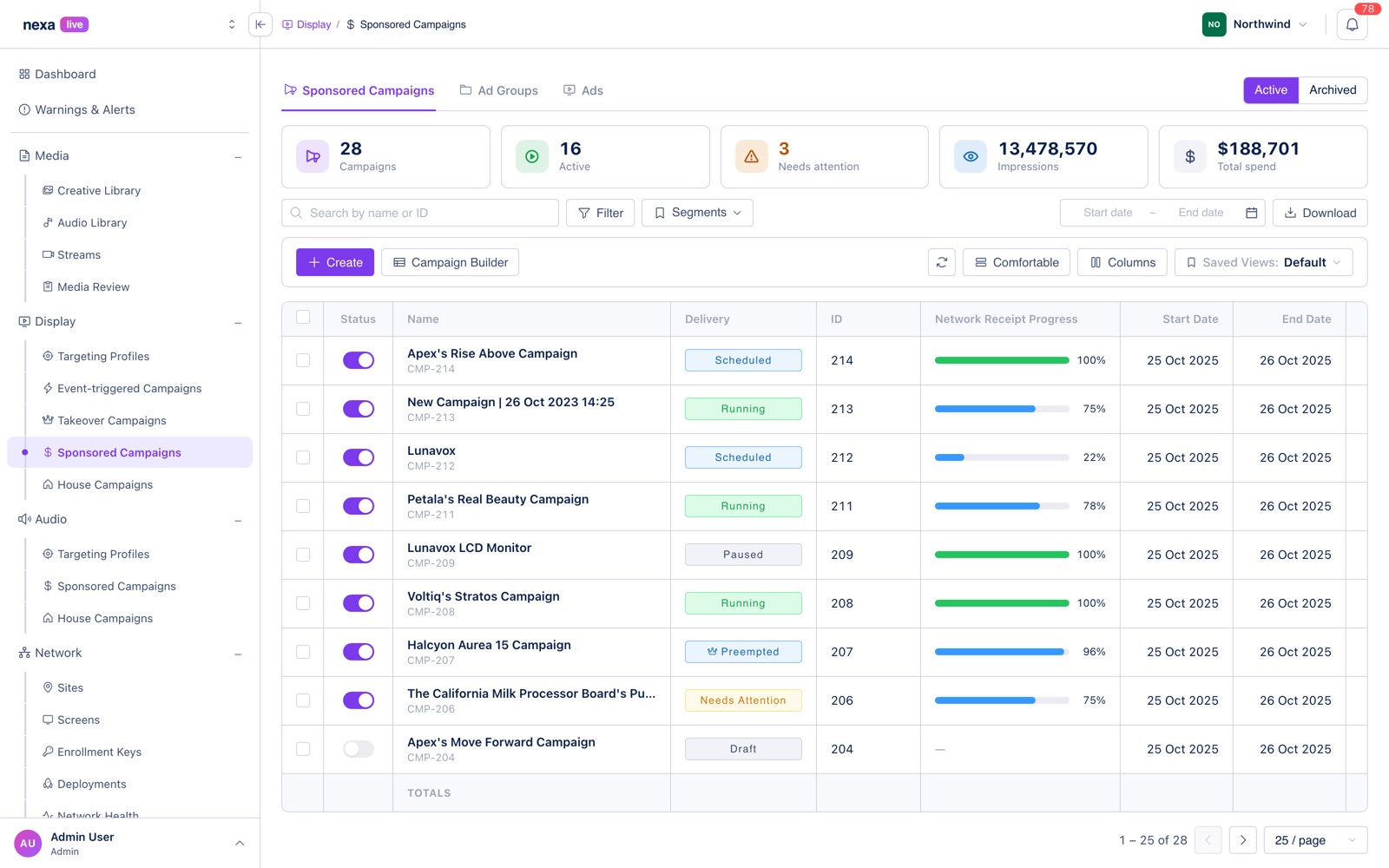
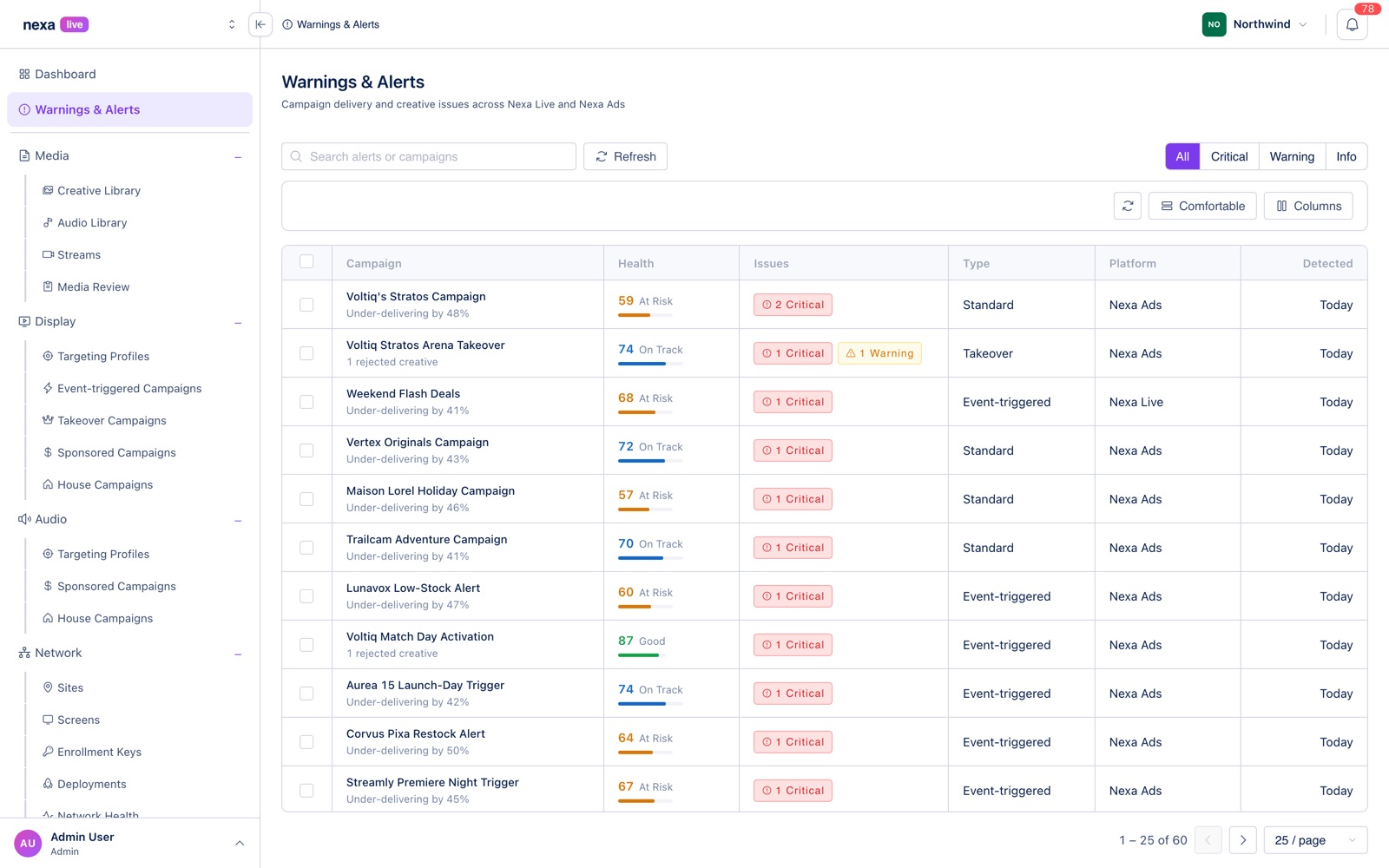
The Warnings & Alerts Center — every alert across both products, filterable by severity, in the retailer product only. It's the operator's queue, and it's the one view that legitimately spans advertisers.
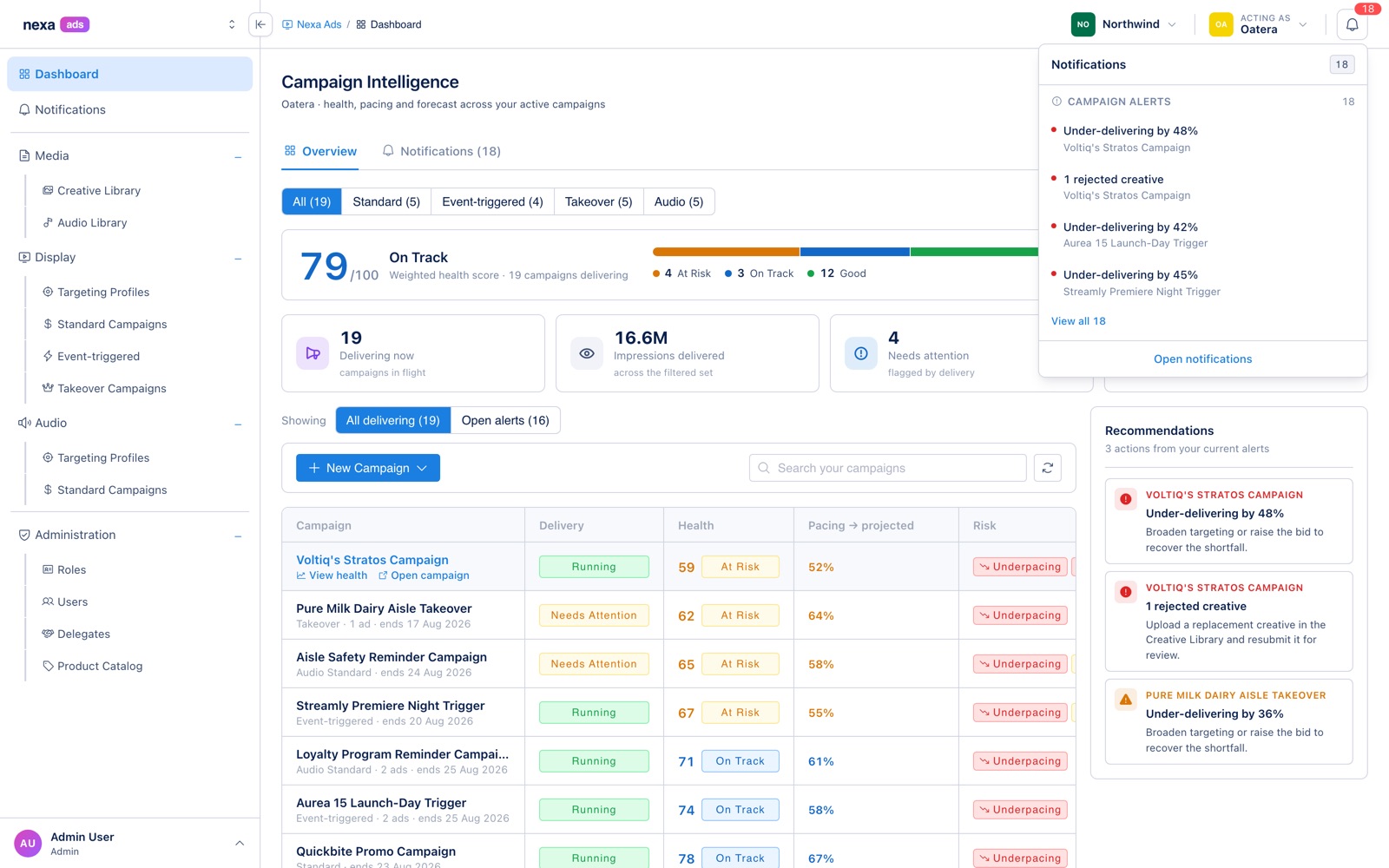
The notification panel and inbox — the header bell, which the PRD found decorative. Read rows stay in the inbox: a notification list that hides what you've read can't show you the same problem tomorrow, and these conditions don't resolve because someone glanced at them. Muting and snoozing exist for that instead.
The advertiser dashboard — the same intelligence, scoped to one advertiser and sorted worst-health-first, with recommendations rendered as buttons rather than as a text column so the alert and the thing that fixes it sit together.
The alert that was right for one audience and wrong for the other
Every alert carries a recommended action and a Fix It route. The creative alerts pointed both audiences at the retailer's review queue — correct for the operator, impossible for the advertiser, who doesn't review their own creatives and doesn't have that page. Fixing it meant making the wording and the destination flip with the product; the full story is in the two-sided architecture case study.
What I'd change
Invent the daily plan earlier. Pacing is the most useful signal in the system and it depended on a field the campaign model didn't have. Adding it was small; discovering that it was missing halfway through designing the scoring model was not.
Make the weights configurable sooner. They're constants today. The PRD asked for a configurable deviation threshold, and the first real operator conversation will ask for weights too — different retailers care about pacing and creative readiness in different proportions.
Keep writing down what can't be built. The blocked-alert inventory was the highest-leverage part of this work. It's also the part that would have been easiest to skip in favour of shipping something that looked complete.